If you have ever tried to get your sleep back on track, you already know the script. You decide you will sleep earlier. You set alarms to start winding down. Dim the lights at nine. Buy the magnesium, melatonin, the blackout curtains, the weighted blanket. You get into bed on time. You try to force the brain into shutdown mode like it owes you a favour.
And then nothing happens.
You lie there, awake. Or you fall asleep for a bit and wake up at 3:17 a.m. like your body is running a separate calendar.
Most people experience this and conclude one of two things: they lack discipline, or they are just bad sleepers - always tired, always a little behind on rest.
There is a simpler explanation. One that does not get spoken about enough.
You are optimising the wrong end of the night.
Bedtime feels like the lever because it is the moment you can see. Wake time feels like an outcome. Biologically, the stronger anchor often comes earlier. Your circadian rhythm is not shaped only at night. It is anchored largely by what happens in the morning, especially consistent wake timing and early light exposure.
What the Circadian Rhythm Actually Is
The word "circadian" comes from the Latin circa diem - roughly, "about a day." And that "about" matters.
Your body has an internal clock - a biological timekeeper made up of roughly 20,000 neurons sitting in a tiny region of the brain called the suprachiasmatic nucleus, or SCN (suprachiasmatic nucleus). This clock tells your body when to be awake, when to sleep, when to release cortisol, when to digest food, when to repair damaged cells. It runs nearly every process you can name.
The SCN does not work alone. It sends signals through hormones, the nervous system, and shifts in body temperature to synchronise smaller clocks in almost every organ - the liver, the gut, the heart, the kidneys, the immune system, the skin. These are called peripheral clocks. Think of the SCN as the conductor, and the peripheral clocks as the orchestra. When they are in sync, the body runs on time. When they fall out of alignment - through irregular schedules, late-night eating, or chronic disruption - the consequences can ripple across metabolism, immune timing, and markers linked to biological ageing.
The catch is that this master clock does not run on exactly 24 hours. In the absence of environmental cues, it drifts slightly - roughly 24.01 to 24.2 hours, and closer to ~24.3 hours in very dim-light protocols. That might sound trivial. It is not.
Even a small daily drift compounds: within a week, your internal clock can be off by more than an hour. Over a month, it can be off by hours. So something has to reset it. Every single day, something has to pull that drifting clock back into line with the actual rotation of the Earth.
That something is light.
Not your alarm. Not your bedtime. Not your intention to sleep earlier. Light is the dominant zeitgeber - the key environmental cue that keeps your circadian rhythm aligned to the 24-hour day. Morning light, especially, is a powerful anchor because it tends to shift the clock earlier and stabilise timing across days.
This is why bedtime is the wrong place to start. Bedtime is what happens after the clock has already been set. If the clock drifted because it never got its morning signal, no amount of winding down at night fully compensates for a clock that never got a strong morning signal. The cause happened - or did not happen - twelve hours earlier, when you woke up.
Sleep researchers call the chronic version of this mismatch social jet lag - a state in which your internal clock says one thing and your schedule demands another. An estimated 70 to 80 per cent of people in industrialised societies experience it to some degree. Not just shift workers. Not just frequent flyers. Most of us.
Why Fixing Your Bedtime Does Not Fix Your Circadian Rhythm
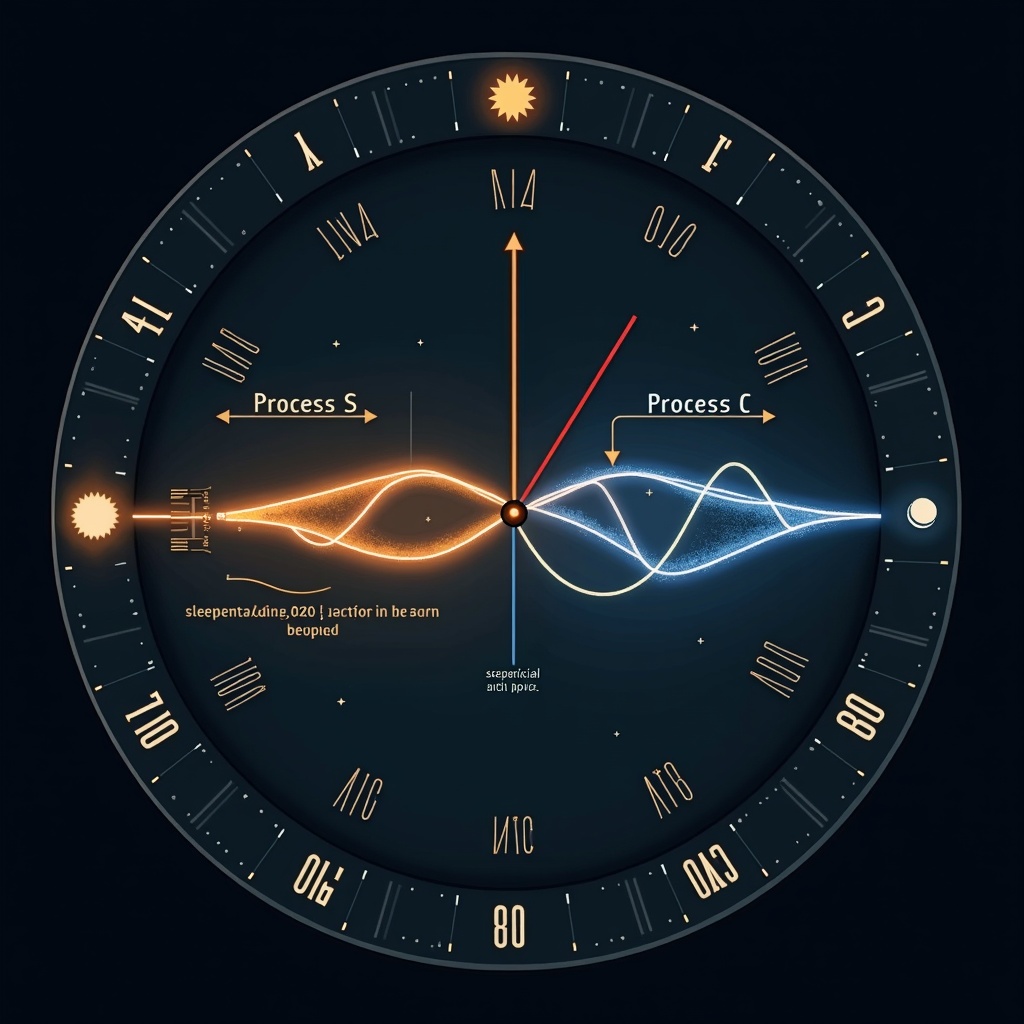
There are two separate systems controlling when you fall asleep. And they do not always agree.
The first is sleep pressure. The longer you have been awake, the more a molecule called adenosine builds up in your brain - a fatigue signal that grows heavier as the hours pass. This is why you feel progressively more tired as the day goes on.
The second is your circadian clock. It runs on its own schedule, independent of how tired you are. It has its own rhythm of alertness and drowsiness that peaks and dips across the day regardless of when you last slept.
Sleep researcher Alexander Borbely first described these as the "two-process model" in 1982, and the framework still holds. Sleep only comes easily when both systems line up. When they disagree, you get the experience you already know - exhausted at 10 p.m. on a Thursday, wide awake. Or alert at 5 a.m. on a Saturday for no good reason.
When you force an earlier bedtime without changing your wake time, neither system cooperates. Sleep pressure is low because you have not been awake long enough. The circadian clock is still on its old schedule because nothing has shifted it. This is not a discipline problem. It is a timing problem. Until wake time and morning light move the anchor, bedtime will keep resisting.
The encouraging part is the flip side. When the anchor moves, bedtime stops being something you enforce. It starts arriving on its own.
How Morning Light Resets Your Circadian Clock
Your eyes do two jobs. The first is seeing - rods and cones (photoreceptors) detecting colour, shape, movement. The second is one most people have never heard of: telling your body what time it is.
About one per cent of retinal ganglion cells are not involved in vision at all. They are called intrinsically photosensitive retinal ganglion cells, or ipRGCs (intrinsically photosensitive retinal ganglion cells) - specialised cells that contain a light-sensitive protein called melanopsin. Melanopsin does not help you see. It detects the presence and intensity of light, particularly short-wavelength blue light around 480 nanometres - the kind abundant in morning daylight. When that light hits these cells, they send a signal straight to the SCN through a dedicated pathway.
The clock is re-anchored. Downstream rhythms begin lining up to that timing. Melatonin - the body's darkness signal, is suppressed by light and typically begins rising later that evening; many feel sleep-ready after they have been awake for roughly ~16 hours.
One of the most striking demonstrations comes from studies of some blind humans who lack functional rods and cones but retain intact ipRGC signalling - they still maintained normal circadian photoentrainment and melatonin suppression. Seeing and keeping time turned out to be two entirely different functions of the eye.
Why Outdoor Light Matters More Than Indoor Light
Light intensity matters, but timing matters just as much. The circadian system responds strongly to the light-dark cycle, and outdoor daylight tends to produce larger phase shifts than the dimmer indoor lighting most of us live under. Domestic lighting can still act as a zeitgeber, but it is usually a weaker morning cue than daylight.
In practice: a short dose of outdoor light soon after waking can deliver a clearer "day has started" signal than staying indoors under typical office or home lighting. On darker mornings, you may simply need longer outside exposure to get the same effect.
You do not need to stare at the sun. You just need to be outside, eyes open, reasonably soon after waking. A walk, a cup of tea or coffee on the balcony, a few minutes in the garden. That is enough.
What Happens When the Clock Stabilises
When wake time is consistent and morning light anchors the circadian rhythm, the changes go well beyond sleep.
Cortisol timing becomes more consistent. Cortisol follows a strong daily rhythm: it is highest in the early morning and falls to a low point at night. When your circadian timing is steady, that curve is less erratic - mornings feel clearer, and nights feel less like your body is still running a daytime programme.
Melatonin arrives more predictably. In the evening, melatonin begins to rise (and is kept low by daytime light). As it rises, core temperature begins to drop and the body becomes more sleep-ready - often after you have been awake for roughly ~16 hours. The bedtime you were chasing starts showing up with less force.
Peripheral clocks synchronise. The master clock helps coordinate clocks across the body, but feeding time is also a powerful timing cue - especially for the liver and gut. When eating and sleeping drift late or become irregular, peripheral clocks can fall out of step with the central clock, and that misalignment is linked to reduced glucose tolerance, higher insulin levels, and higher inflammatory markers.
Sleep is the most visible consequence of a stable circadian rhythm. It is not the only one.
How to Reset Your Circadian Rhythm
Pick a wake time. Stick to it. It does not need to be early - it needs to be consistent. If you wake at different times on weekdays and weekends, you are resetting your clock to a different schedule every few days - the biological equivalent of flying across time zones every weekend.
Get outside within the first hour. Five to ten minutes on a clear morning. Fifteen to thirty on a cloudy one. Leave the sunglasses off.
The first few days will feel worse, not better. If your clock has drifted, pulling it back means waking before your body thinks it should. That grogginess is not failure - it is the drift correcting. For many people, falling asleep in the evening starts to feel easier once the clock begins to re-anchor. Not because they forced it, but because the timing shifted underneath it.
This Is Not About Becoming a Morning Person
People vary in their natural sleep timing - early chronotypes, late chronotypes, and everything in between. This variation is real, partially genetic, and shifts across the lifespan.
There is a reason it exists. A 2017 study of Hadza hunter-gatherers in Tanzania found that over 20 days of continuous recording, all subjects were simultaneously asleep for a total of just 18 minutes. At any given point during the night, someone was always partially alert. Evolutionary biologists call this the sentinel hypothesis - in group-living species, staggered sleep timing means someone is always on watch. Chronotype variation is not a flaw. It is species-level survival architecture.
The goal is not to change your type. It is to reduce the gap between where your clock naturally sits and what your day demands. A consistent wake time and morning light do not turn owls into larks. They tighten the system. They reduce the drift.
Your circadian rhythm does not primarily need another sleep gadget. It needs what biology has relied on for billions of years: consistent environmental timing cues, especially light.
The signal is simple. It arrives every morning. Most of us stopped structuring our lives around it.